Member Login | Become a Member
International Packaged Ice Association
  • Home
  • About
    • Our Team
    • Executive Committee
    • Board of Directors
    • Committees
    • Past Chairmen
    • Contact Us
  • Association
    • Our Mission
    • Advocacy
    • PIQCS
    • Sustainability
    • Awards
    • Scholarships
  • Membership
    • Join The IPIA
    • Membership Brochure
    • Member Login
  • Events & News
    • 2025 Convention
    • 2025 Exhibitor Prospectus
    • 2026 PCQI Workshop
    • Convention History
    • Newsroom
  • Resources
    • All About Ice >
      • History of Ice
      • Ice Facts & Myths
      • Ice Studies
      • Ice Contamination
      • Package Labeling
    • Consumers & Retailers >
      • Consumer Tips
      • Emergency Ice
      • Event Ice Calculator
      • IceWatch
      • Retailers
    • Chapters/Affiliates & Regional Ice Associations
    • Plant Operations
    • Ice World Journal
    • SafeIce.org
  • Find A Member
    • Member Directory
    • Supplier Showcase
  • Home
  • About
    • Our Team
    • Executive Committee
    • Board of Directors
    • Committees
    • Past Chairmen
    • Contact Us
  • Association
    • Our Mission
    • Advocacy
    • PIQCS
    • Sustainability
    • Awards
    • Scholarships
  • Membership
    • Join The IPIA
    • Membership Brochure
    • Member Login
  • Events & News
    • 2025 Convention
    • 2025 Exhibitor Prospectus
    • 2026 PCQI Workshop
    • Convention History
    • Newsroom
  • Resources
    • All About Ice >
      • History of Ice
      • Ice Facts & Myths
      • Ice Studies
      • Ice Contamination
      • Package Labeling
    • Consumers & Retailers >
      • Consumer Tips
      • Emergency Ice
      • Event Ice Calculator
      • IceWatch
      • Retailers
    • Chapters/Affiliates & Regional Ice Associations
    • Plant Operations
    • Ice World Journal
    • SafeIce.org
  • Find A Member
    • Member Directory
    • Supplier Showcase
ICE IS A FOOD PRODUCT. 

Problem is, legislation doesn't reflect that fact.  And the laws that do, often go overlooked.

The end result? Ice becomes contaminated with harmful pathogens and consumers get sick and, in some cases, even worse.​


THE SCIENCE PROVES IT
Picture
​​Over the years, academic studies have documented dozens of foodborne illness outbreaks caused by contaminated ice.  Ice produced and bagged at retail locations, such as convenience stores, liquor stores, fast-food restaurants, and self-serve machines, often exceeds acceptable levels of bacteria.  For consumers, this continues to trigger serious illness and even death. 

At IPIA, our mission is to help protect consumers.  Our member ice manufacturers are committed to producing a quality, safe ice product - completing annual audits to maintain accreditation according to our Packaged Ice Quality Control Standards (PIQCS).

To secure the safety of your consumers, ask for a copy of your ice manufacturer's IPIA PIQCS accreditation certificate or check out our ​online member directory.
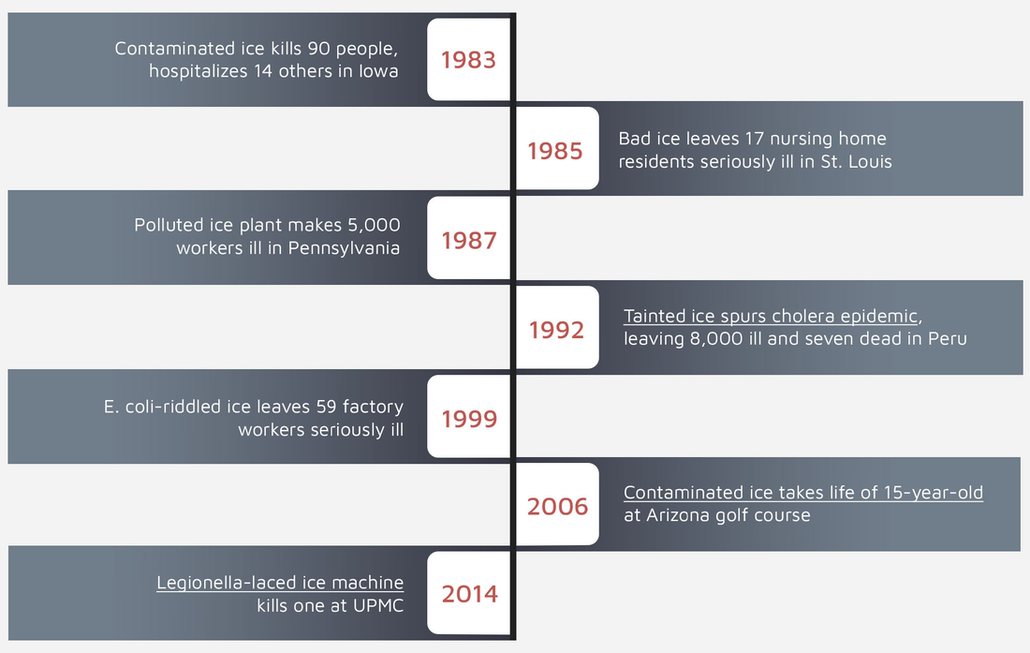
SCARY STORIES OF BAD ICE
Picture
See: 1992; 2006; 2014
Does it REALLY matter where you buy your ice from?
As a retailer, you demand and sell top quality bottled water.  Demand the same of your ‘frozen water’ packaged ice.  Most major retailers prefer to sell IPIA-accredited packaged ice for their protection and for the protection of their customers.  When shopping for a packaged ice supplier, ask yourself - would you risk selling an inferior and even potentially contaminated food product to your customers? 
 
​The quality and safety of the packaged ice produced by members of the International Packaged Ice Association is of utmost priority for the protection of the consumer.  IPIA members chose to adhere to strict sanitation standards as defined in our PIQCS (Packaged Ice Quality Control Standards) program.  These standards are audited annually in all IPIA member plants by NSF, the National Sanitation Foundation, a worldwide leader in food safety solutions and monitoring.  These standards are FSMA (Food Safety Modernization Act) compliant.
 
Packaged ice when purchased is used not only for consumption, but also for refrigeration - and the quality of ice used for refrigeration purposes is just as important to reduce the risk of cross-contamination with other food products that may come in contact with the ice.  

The freezing process kills bacteria, right?  WRONG.
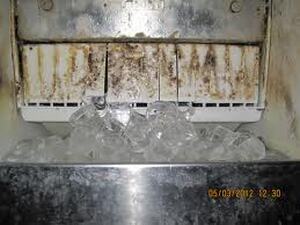
Freezing only slows down the rate of bacterial growth. Studies show that ice can be contaminated with E. coli, salmonella, staph, yeasts and molds, among other pathogens. Ice machines look like the image shown because they are not cleaned and sanitized weekly and have great potential to make your customers sick.

​And then there is the food safety training necessary for employees who might be bagging the ice for sale.  Handling of the ice can cause contamination if proper hygiene and sanitary procedures are not followed.  Recorded outbreaks traced back to infected workers have included salmonella, hepatitis A, and E. coli. 
Picture
​Did you know that most ice machine carbon filters remove the chorine from the public water supply coming into the machine?  With no chorine (a disinfectant) in the water freezing into cubes, the wet environment of the ice machine surfaces grow mold, slime and bio-films quickly - all potentially harmful if consumed.

Have you considered the ice packaging itself?
Stock bags purchased from commercial supply houses often do not meet federal labeling laws.  Plus, since ice packaging is a food contact surface, can you guarantee it is FDA-approved food grade? These issues need to be taken into consideration for the safety of the consumer purchasing this product from you.

Thinking of making/bagging your own ice?
On the surface it might appear in store production will produce spectacular profits.  But, take a moment to consider the true cost of producing your own ice.  What do the manufacturers of in-store ice machines include in their figure?  Only the variable costs – water, electricity, bags, and some labor.  Consider the cost of the ice maker, the storage freezer, the store space, the maintenance and cleaning of the equipment, personal property taxes, insurance, shrinkage, and how many bags you will need to sell to pay off the equipment purchases.

Looking to sell IPIA member-manufactured packaged ice?
Not only is packaged ice a high-margin item for retailers and a top seller in the frozen food category, but the many partner products (e.g. soda, beer, bottled water) create high extra ring totals.  Click here to find an IPIA-accredited ice provider near you.
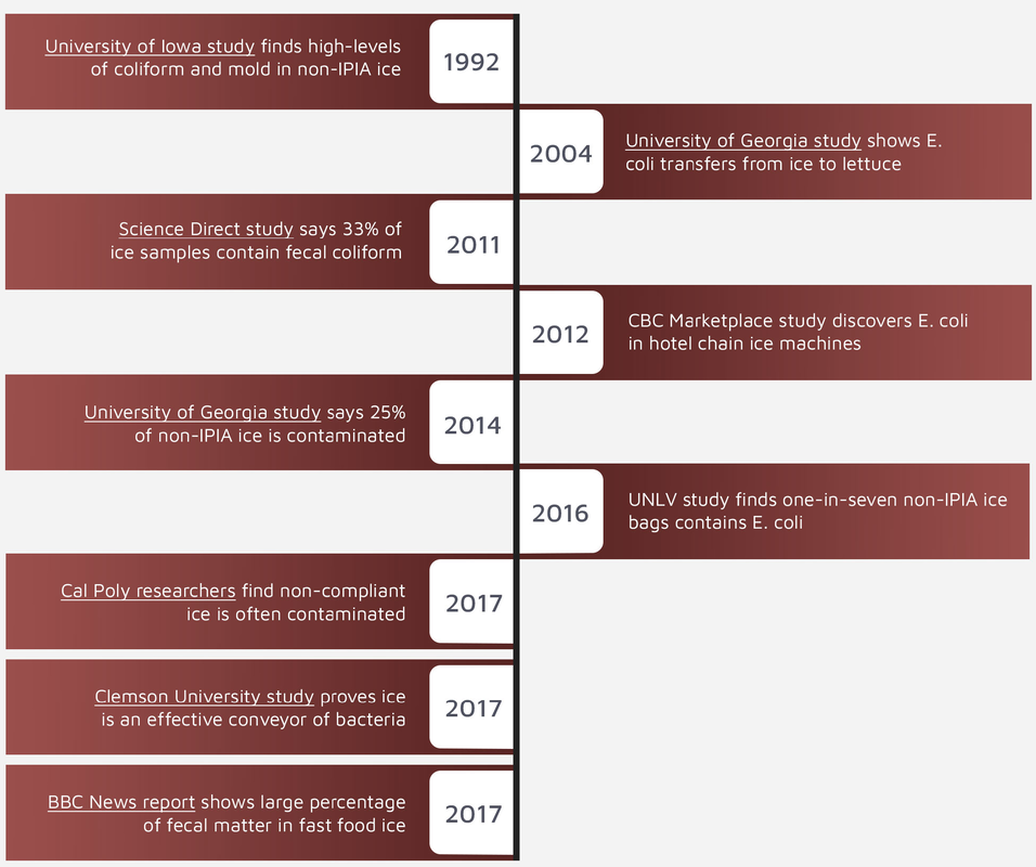
HORRIFYING FINDS BY RESEARCHERS
Picture
See: 1992; 2004; 2011; 2014; 2017: Cal Poly; Clemson; BBC

Get in Touch With Us

Submit
Copyright International Packaged Ice Association.  All Rights Reserved.
1519 Dale Mabry Highway, Suite 202, Lutz, FL 33548

Contact the IPIA
The IPIA name/logo collective registration mark found on this site may not be used by any IPIA non-member in any advertising or publicity, or otherwise to indicate IPIA’s affiliation with any product or service. Although the IPIA site includes links providing direct access to other internet sites, IPIA takes no responsibility for the content or information contained on those other sites, and does not exert any control over those sites. IPIA is providing information under this site and makes no representations about the suitability of this information for any purpose. © 2024
Picture
IPIA members recognize the importance of proper disposal of packaging.